|
Other Stories In This Edition
VIEWPOINT: 21st Century Fibers
Montefibre Shifts to Polyester Staple and Nonwovens Markets
World Output Stagnates: US, Japan, Western Europe Post Declines as China Grows
Breaking the Speed Barrier in POY Spinning
Creativity, Push into New Markets Keys to Survival for Commodity Fiber Producers
Fiber Market Poised for Gradual Recovery
Enka Tecnica's New MD Sets Growth Strategy
Unifis High-Tech POY Plant CelebratesFirst Anniversary at Full
Norwegian Rope Makers Depend on ESL Embossed Filament Lines
Zenith Opens Gear Pump Facility in England
Paris ITMA Showcases Latest in Fiber Production Machinery
Calendar
Sections
Advertise
IFJ Buyers Guide
Contact IFJ
Calendar
In This Edition
Return to Main Page
Reprints
Reader Reply Card
Subscribe to IFJ
|
   
   
August 1999 - Volume 14 Issue 4
Viewpoint: 21st Century Fibers
More efficient and ecological processing, greater fiber
performance, and possible return to biopolymer platforms
Arun P. Aneja and
John P. OBrien, DuPont Co.
Over the last 60 years, the textile business has enjoyed rapid growth in synthetic fibers which has been fueled largely by seminal discoveries in polymer and fiber science. Fiber and textile manufacturing facilities also have undergone enormous improvements in automation and simplification where large-volume fiber production facilities today may require only tens (instead of hundreds) of personnel for their operation. Fibers which have ease of care and natural-like aesthetics have been major themes in recent decades, with high performance and specialty fibers taking on particular significance.
Looking to the next millennium, the textile industry stands in stark contrast to its preeminent position of just 20 years ago. Many of the synthetic fiber products that once fueled the rapid growth of the industry have become mature commodity products now characterized by low growth and lower profit margins.
Intense global cost pressure, higher consumer expectations, a highly diverse customer base and reduced R&D spending have all contributed to sluggish growth in current textile businesses. The challenge for the future is to revitalize the industry through technological innovations in products and manufacturing and to reevaluate business practices in a global context.
Textile Processes of the Future
Ecological Factors
There is a growing trend in the industry to develop flexible, low-cost manufacturing facilities to broaden product offerings within new and existing facilities. High-speed extrusion and weaving processes, on-line analytical measurements, modular plant construction and simplified manufacturing streams are examples of improvements being made today.
Biological processes may play a special role because of their inherent flexibility. A fermentation process, for example, can provide polymers and intermediates in the same facilities by genetic modification of a host organism to change the product stream. The United States has a vast and renewable biomass resource in agricultural crops, forests and grasslands. While some technological hurdles remain for its greater and more cost-effective utilization, the chemical and biological transformations necessary to convert biomass into useful intermediates and polymers has already been defined for many substances.
Biological sciences may provide needed answers, leading to product alternatives more compatible with the ecosystem. Whatever the approach, future processes will focus on waste elimination through the reduction and reuse of sidestreams and process redesign to derive useful products from waste streams.
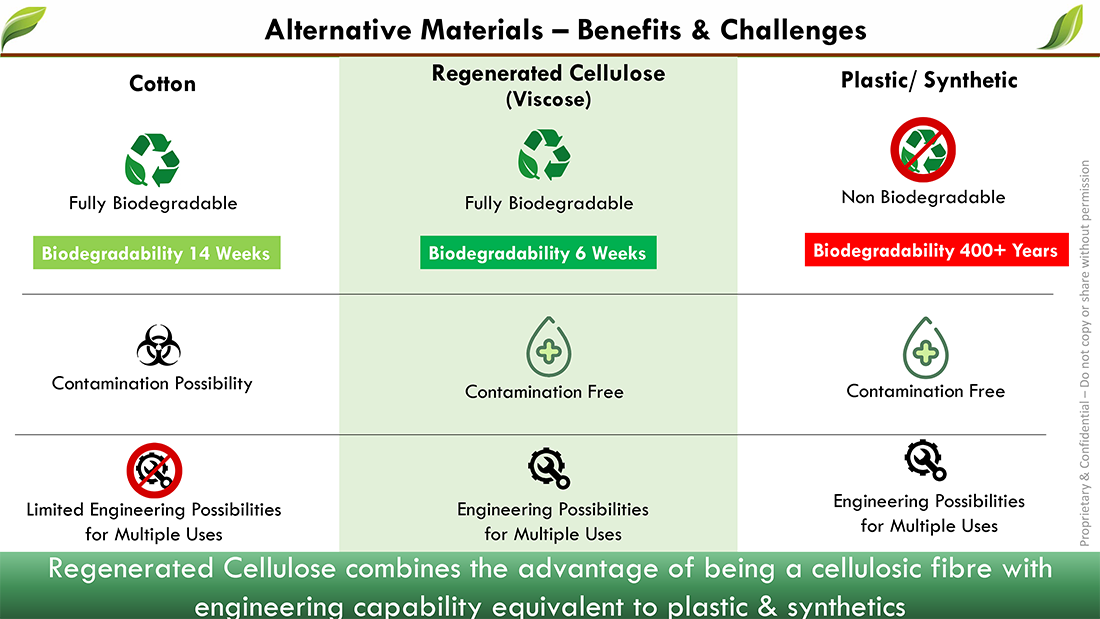
The success of textile products of the future will be dependent upon life-cycle efficacy and utility from ingredients to disposal. It is widely perceived that natural fibers are ecologically benign. While it is true that natural fibers are biodegradable, the negative effects of pesticides, fungicides and fertilizers used in their production are often overlooked. Advances in biology and genetics are now yielding disease resistant and naturally colored variants of cotton; hence improvements in natural fibers will continue to provide new offerings in this important market segment.
Biodegradable Fibers
Some synthetic fibers can take many years to convert into components fully assimilated by the environment. Research is underway to dramatically accelerate that process through the development of biodegradable fibers. It is likely that some synthetic fibers will remain in the marketplace only if they can be reconverted to raw materials at an acceptable cost or can be made to be biodegradable.
In the case of polyester, waste can be recycled to ingredients and back to new products through a process called methanolysis, effectively closing the recycle loop for the polyester platform. Hence, it would be possible to keep polyester-based articles in circulation and out of landfills indefinitely.
Recycling technologies for nylon are also well advanced and waste carpets can be recycled. The conversion of acrylic fibers to ingredients and subsequent recycling is not yet possible and as a result acrylic fibers are expected to continue to lose market share.
Many current production processes use metal catalysts for polymerization, which can be harmful to the environment. Antimony and cobalt catalysts are being replaced, in the case of polyester by a new generation of zeolite-based compounds which provide higher polymer yields. With the new higher productivity catalyst technology, first-pass yields can be greater than 95% and waste is dramatically reduced.
Dye houses have had to deal with the daunting problem of effluent discharges. New technologies which employ biocompatible dyes will be developed for fabric finishing and dry cleaning. Since fine filament count yarns need significantly more dye to achieve the desired color level, concerns with excess dye in process water in both manufacturing and home laundering processes are magnified.
DuPont is attempting to meet this problem with the use of reactive dye technology.
Emerging products in this arena include DuPonts TACTEL® COLORSAFE®, which has outstanding (ISO 4-5) wash fastness while requiring far fewer chemicals versus conventional dye technologies. Benefits accrue to both the consumer and fiber producer in providing enhanced color longevity in the product and an environmentally benign process. Reactive dye technology may well become an industry standard in the 21st century.
Production and Manufacturing Technologies
Commodity fiber technology is generally mature and broadly available to investors. As a result competitive advantages in process technology are vanishing rapidly and the future will be driven by other forces. These will include a highly competitive world market in which exceptional quality and process efficiency will dominate among high- volume producers.
Commodity fiber production will probably be carried out by an increasing number of suppliers while specialty fiber products will be limited to a few large manufacturers with the technical expertise to support their development. Vertical business alliances will provide easy market access and reduced risk to remain competitive. Consistent global pricing for intermediates and finished products will become a reality and the value chain will collapse with control subsequently moving downstream to the retail level.
Major cost reductions and productivity improvements have been achieved in the textile sector over the last decade. Processing innovations include automated operations, increased spinning speeds, elevated production capacities and process simplification. Differences in production cost among various fiber manufacturers is governed by the investment cost and level of feedstock integration. New plant investment is determined by scale, raw material conversion efficiency, and process parameters such as spinning speed, drawing/texturing steps and quench technology.
Polymer reactor sizes have steadily increased from about 50 tons/day in the 1970s to current levels of about 300 tons/day. During that same period, filament spinning speeds have increased from 3000 m/min to up to about 7000 m/min for fully oriented yarns and are at about 3000 m/min for partially oriented yarns. Texturing speeds have increased from about 700 m/min to 1000 m/min.
In staple fiber, improvements in productivity have been the result of larger machines and not spinning speed. Specifically, line capacity has increased from 70 tons/day a decade ago to current levels of about 150 tons/day. Key to this improvement has been precise thermal control of the process, improved polymer quality and high-efficiency machines.
Future manufacturing technologies will provide lower costs and greater efficiencies through automation; especially through the use of robotics. Energy consumption will approach that required for stoichiometric conversion. Manufacturing processes will be highly stable and closely approach 100% yields. New reactor schemes for polymer synthesis will be developed to dramatically reduce production cost and increase capacity. Exact control of fiber structure will possibly allow high speed (5000-8000 m/min) partially oriented filament yarns or fully drawn yarn at 10,000 m/min with no subsequent draw step. Highly efficient quench technologies will undoubtedly play a prominent role in delivering desired product attributes in a less expensive and more consistent manner.
Future fiber manufacturing technology must also accommodate mass customization in the market place. Hence a system of specialized product variants from small-lot production will provide high value-added products to the consumer. The challenge for the future will be in the development of efficient small-scale production technology for such products.
Engineered Multifunctional Textiles
There is an increasing need for fabrics which can combine strength functionality, attractive hand/tactility and enhanced mill value at a competitive cost. Synthetic fibers such as nylon, polyester and polypropylene were developed as alternatives to natural fibers and represent second-generation products. We suggest that third-generation textiles, obtained from precisely specified polymers, will provide broader and more tailored functionality over a wider range of end uses.
Passive Performance Fibers
For example, at DuPont, we have engineered fibers for moisture transport in the design of COOLMAX fabrics which efficiently move moisture away from the skin. Perspiration migrates via capillary action along fiber channels where it reaches the surface for fast evaporation.
THERMASTAT® fibers are designed with a hollow core similar to that found in polar bear fur and provide comfort over a large range of temperature and activity levels. The fabrics wick moisture from the skin and trap warm air efficiently, thus reducing the number of layers of fabric needed to maintain comfort. Warmth is retained in the hollow fiber core and radiant heat loss is minimized.
Silk is among the finest of natural-sourced fibers. Over the last decade new synthetic fibers, which have significantly reduced fiber diameters (in the subdenier or less than one denier per filament range) have been introduced. Soft, supple and comfortable fabrics have resulted which are lightweight, durable, quick drying and vibrantly colored. Polyester microfiber products offer aesthetics previously found only in natural fibers. Microfiber filaments can lower the stiffness of the fiber five-fold leading to extremely soft fabrics in blends with rayon, cotton, or silk; often with drapabilities exceeding those of the natural fibers alone.
Future textiles will make use of engineered structures other than fibers. Down is highly prized by consumers for its insulating properties and newly engineered constructions (such as fiber clusters) promise to provide products with exceptional thermal performance along with superior softness and drapability.
Active Performance Fibers
Clothing for the next millennium will employ active fabrics which do not require work from the human body to provide their benefits. For example, materials which retard heat loss are now being prototyped in ski apparel. It seems likely that such technology will further advance to the point that clothing which not only improves the wearers comfort but enhances performance will become commonplace.
As the interfaces between information science, materials and biotechnology merge, adaptive garments that sense temperature differences and react to them in a predetermined way are foreseen. Shirts and blouses of the future may act as insulators when it is cold while efficiently radiating heat in warmer weather. Such garments will offer constant thermal comfort during fluctuations in temperature in a way that is virtually transparent to the wearer.
Conclusions
Fiber and textile product development in the 20th century has been based mainly on condensation and addition-type polymer platforms with an array of customized additives and modifications that significantly expand their functionality and properties. Advances in fiber science and engineering have further resulted in a family of engineered fiber structures which broaden the performance envelope of these polymers. Future polymer molecules will have a higher level of design, functionality and production efficiency arising from advances in precision synthesis, controlled molecular self-assembly processes and advanced manufacturing technologies.
Initial demonstrations in creating synthetic analogs to spider silk illustrate the kinds of opportunities that exist for a materials revolution driven by the precise specification of molecular architecture. By using recombinant DNA methodology and learning how a spider makes its silk, we have made synthetic variants of silk as models for next generation materials.
In this approach, advanced computer simulation techniques have been employed to integrate all of the information available about the structure and composition of this unusually strong and elastic natural fiber. It is indeed ironic that fibers in the next millennium may represent a return, in part, to biopolymer platforms since the richest era of textile growth witnessed in this century has been driven by the replacement of natural fibers.
Dr. Aneja is Senior Research Associate at DuPont Co. Dacron Research Laboratory, Kinston, North Carolina 20501 USA. Dr. OBrien is Research Fellow at DuPont Central Research and Development, Wilmington, Delaware, 19880 USA. This article is excerpted from a larger work, "Fibers for the Next Millennium," which will be published in October this year by the Society of Dyers and Colourists (United Kingdom) in its annual Review of Progress in Coloration publication.
 |